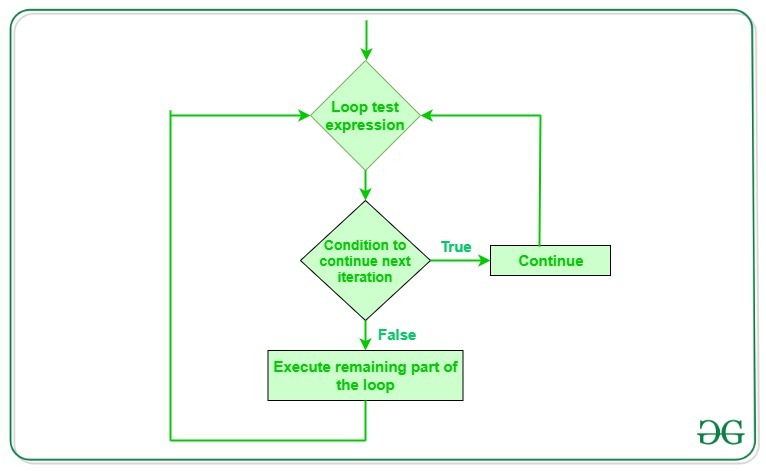
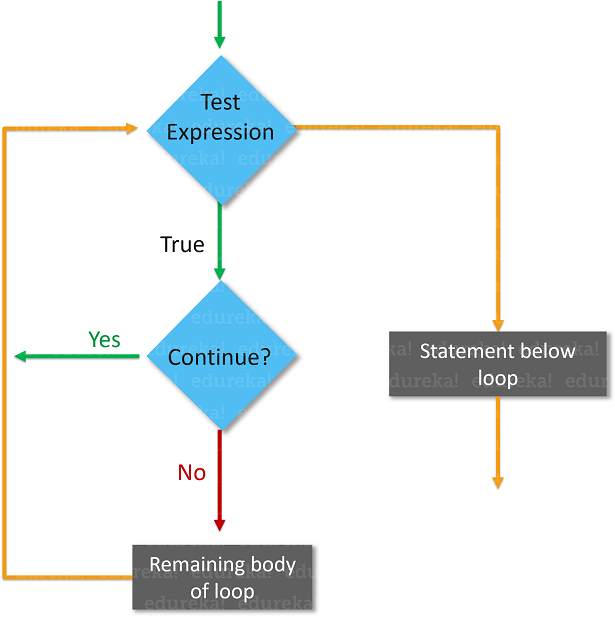
Ruby next keyword skip iteration the next keyword allows you to skip one iteration.
Ruby each loop continue.
The first one is the element and the second one is the index.
When writing a loop you may want to skip an iteration or to end the loop early.
Each loop will take a list of variables and run a block of statements for each of them.
Let s find out how to use them.
A b c each with index el i puts i 0 1 2.
Since almost all computing tasks use lists of variables and have to do something with each of them in the list the each loop is by far the most common loop in ruby code.
Next let s look at adding conditions within a loop by printing all even numbers from 0 up to 10.
In ruby we use a break statement to break the execution of the loop in the program.
Like a while loop the condition x 11 is checked when entering the loop and each time the loop body executes.
It s sometimes useful to know where you are in the list so for that you need to have an index.
Executes code once for each element in expression.
Note that break will not exit the program but only exit the loop and execution will continue on from after the loop.
The each loop the eachloop is perhaps the most useful of all the loops.
This works exactly like the each method for an array object with one crucial difference.
The ruby each loop the ruby method each allows you to go over a list of items without having to keep track of the number of iterations or having to increase some kind of counter.
If the condition is false the loop will continue to execute.
That s where the next break keywords come in.
Ruby while loop n x 1 end output.
Live demo usr bin ruby for i in 0 5 puts value of local variable is i end here we have defined the range 0 5.
It s the ruby way of doing repeat until done.
Finding out current index in an each loop.
While each doesn t give you that you can use each with index.
Like the array these elements are placeholders that are used to pass each key value pair into the code block as ruby loops through the hash.
X 1 y 11 until x y do print x.
For a hash you create two elements one for the hash key and one for the value.
Before you can use each you need a collection of items like an array a range or a hash.
Ruby loops loops in ruby are used to execute the same block of code a specified number of times.
This chapter details all the loop statements supported by ruby.
It is mostly used in while loop where value is printed till the condition is true then break statement terminates the loop.