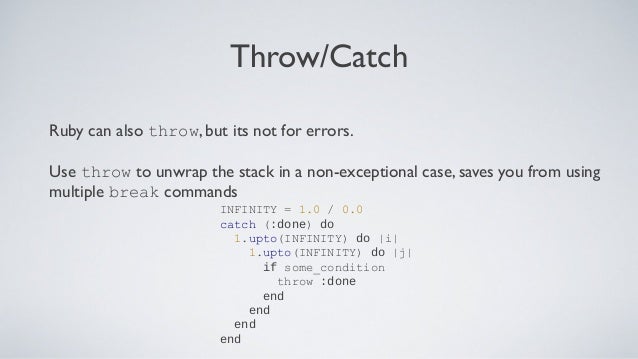
Catch and throw is similar raise and rescue keywords exceptions can also be handled using catch and throw keywords in ruby.
Ruby catch exception.
The block is executed normally until a throw is encountered.
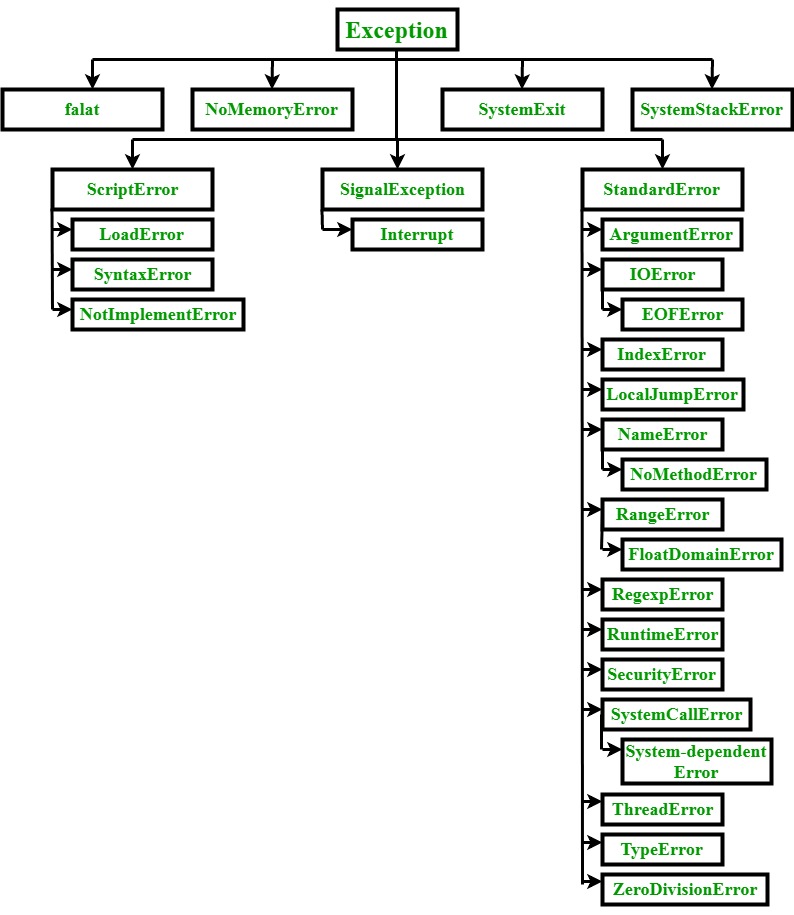
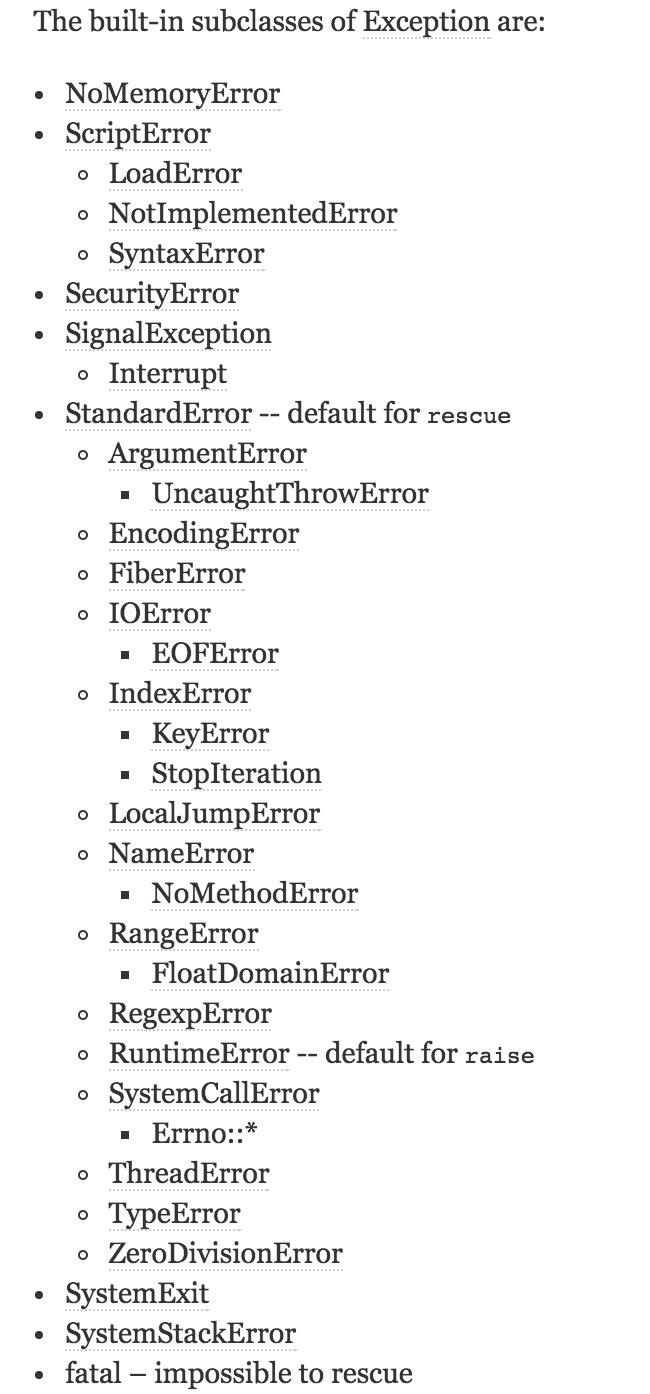
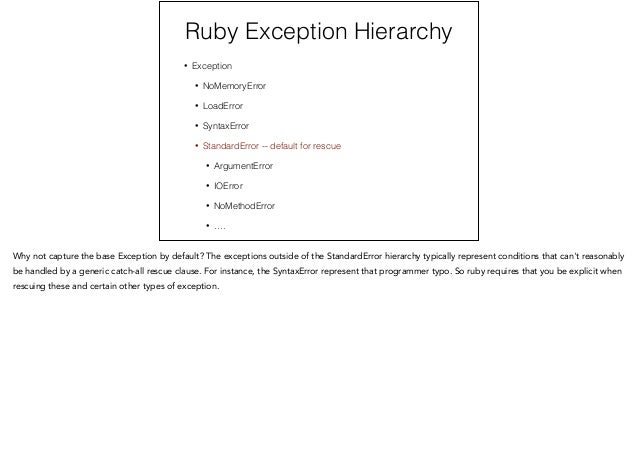
The ruby standard library defines about 30 different subclasses of exceptions some of which have their own subclasses.
When ruby encounters a throw it zips back up the call stack looking for a catch block with a matching symbol.
Catch defines a block that is labeled with the given name which may be a symbol or a string.
Throw keyword generates an exception and whenever it is met the program control goes to the catch statement.
All the exception classes form a hierarchy with the class exception at the top.
An exception is a special kind of object an instance of the class exception or a descendant of that class that represents some kind of exceptional condition.
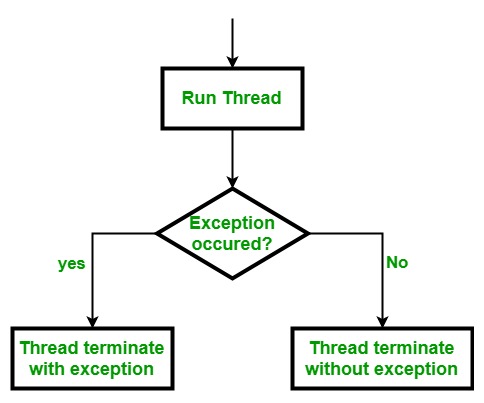
By default ruby programs terminate when an exception occurs.
A beginner s guide to exceptions in ruby.
In a nutshell every custom ruby exception should extend standarderror rather than the exception class the reason for this is outlined in exception handling in ruby with this in mind the simplest custom exception class that we can define will look something like this.
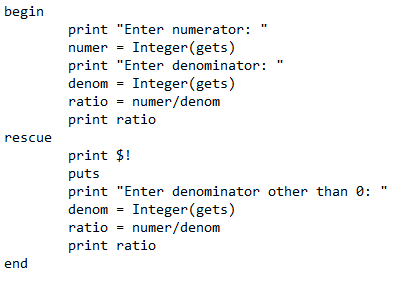
As we know the code enclosed between begin and end block is totally secured for handling exceptions and the rescue block tells the ruby the type of exception is to be.
When this occurs an exception is raised or thrown.
This article will discuss the use of exceptions and show some examples of how to deal with them.
Ruby s standard classes and modules raise exceptions.
Ruby exceptions access control toc logging raising an exception.
When it finds it ruby unwinds the stack to that point and terminates the block.
The throw catch paradigm works similarly to raise and rescue.
The exception mechanism in ruby is very powerful but often misused.
The block is executed normally until a throw is encountered.
The catch defines a block that is labeled with the given name which may be a symbol or a string.
Ruby has a distinctive language feature that consists of pairs of throw and catch statements.
Catch lable name do matching catch will be executed when the throw block encounter throw lable name.
Here s some code to illustrate.
An exception is an unwanted or unexpected event which occurs during the execution of a program i e at runtime that disrupts the normal flow of the program s instructions.