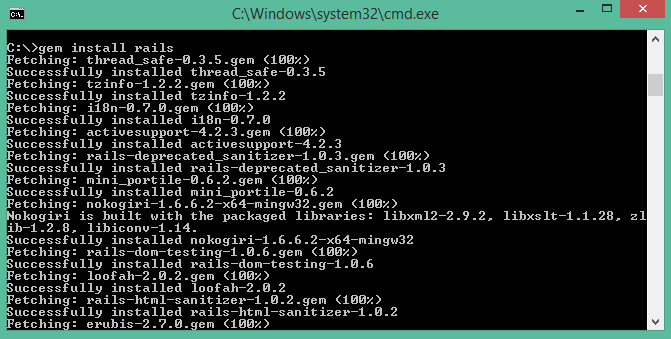
Before you start you will need to install ruby on rails on your machine.
Ruby bundle install path.
If a gem isn t cached or installed bundler will try to install it from the sources you have declared in your gemfile.
Most repositories ended up explicitly updating rubygems in ci to make bundler 2 0 0 work as mentioned in the original blog post.
Bundle config path gem to start a new bundle.
All versions of ruby supported by bundler 2 that is ruby 2 3 ship with rubygems 2 5 or newer but the blog post did not make this clear.
If your system gems are stored in a root owned location such as in mac osx bundle will ask for your root password to install them there.
In this case bundler adds the bundle config file to a project s root.
Bundler prevents dependencies and ensures that the gems you need are present in development staging and production.
While installing gems bundler will check vendor cache and then your system s gems.
Bundler is an exit from dependency hell and ensures that the gems you need are present in development staging and production.
Rubymine processes this configuration file to detect that gems are installed into vendor bundle.
There are multiple options you can.
Once the installation is finished run bundle install this will create gemfile lock in your repository.
Starting work on a project is as simple as running the bundle install command.
This resulted in a lot of confusion.
Bundler provides a consistent environment for ruby projects by tracking and installing the exact gems and versions that you need.
To correct this you can run the following command.
Starting work on a project is as simple as bundle install.
Wait until gems are installed.
This ensures that other developers on your ruby application run the same third party code on every machine.
Bundler provides a consistent environment for ruby projects by tracking and installing the exact gems and versions that are needed.