This is a list of 27 basic pieces of laboratory equipment you would find in a general chemistry lab.
Rubber stopper laboratory apparatus uses.
We carry stoppers both with and without pre drilled holes in a wide range of the most common sizes.
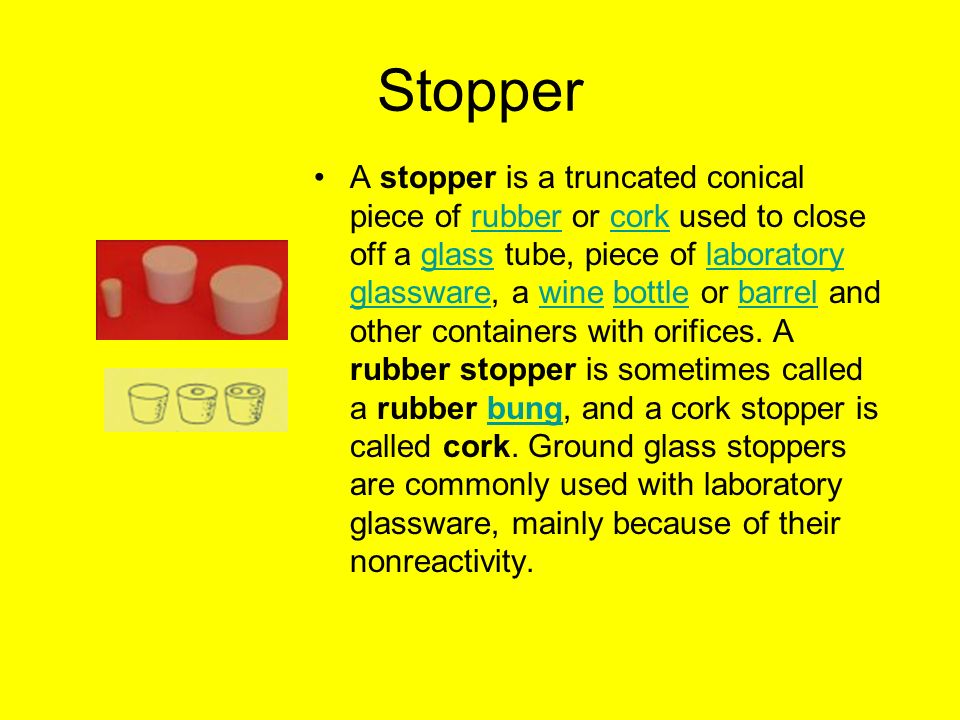
In chemistry bungs made of hardened rubber are frequently used in small scale experimental set ups involving non corrosive gases some chemistry bungs may also include one or more holes so a glass tube or laboratory funnel may be inserted through the bung and into the container or another piece of apparatus.
Used to hold test tubes.
For small test tubes use 00 stoppers.
As the rubber stopper is used in many experiment some specific experiment.
Some lab work requires a full setup of glassware.
The rubber bung may be used to seal a flask because the user may require the contents.
Each is named explained and shown in a picture.
Improper utilization of lab equipment can lead to serious injury.
Learn about some common pieces of laboratory equipment and how to use each one properly.
The narrow opening also allows for the use of a rubber or glass stopper.
Rubber stoppers are ideal for plugging joints or holes in laboratory glassware and creating a liquid tight seal.
A laboratory rubber stopper or a rubber bung is mainly used in chemical laboratory in combination with flasks and test tube and also for fermentation in winery.
Use a cork borer to drill holes in the.
You ll need one or two hole rubber stoppers for those experiments and use 5 mm glass tubing to connect to other apparatus.
Used to hold a hot test tube.
Stoppers can have holes for thermometers and for other probes that may be used.
They enable us to carry out experiments successfully and make accurate measurements or observations.
It can easily be clamped to a ring stand discussed below as well as heated or shaken mechanically.
Rubber bungs are often used with glass containers such as test tubes flasks jugs and many other pieces of standard lab equipment.
The primary purpose of a rubber stopper is to prevent a gas or liquid from escaping its container during a scientific experiment.
Use 6 5 stoppers for 250 ml flasks.
The sizes are from 0 to 8.
Many types of apparatus are used for scientific work in the laboratories.
However we have compiled all possible common and comprehensive list of 20 laboratory apparatus and their uses.
Lab equipment and uses.
Commonly encountered equipment in the chemistry laboratory.
Used to clean test tubes.
Generally in laboratory the sizes of rubber stopper can be varied up to approximately 16 sizes and each of it is specific to certain type of container.
Used to mix heat or store substances.
Aids in pouring liquids into small openings without spilling them.
All common laboratory apparatus should be drawn in outline only and in their correct proportions.
Rubber stoppers can also prevent the contamination of samples by protecting the contents of laboratory glassware from air.
Rubber stopper stoppers come in many different sizes.